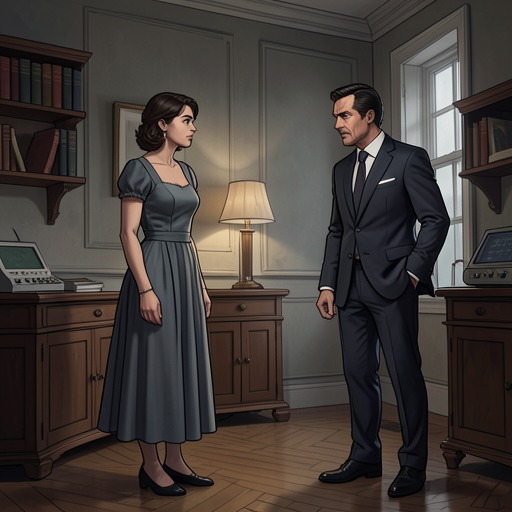
Lily Briscoe and Charles Tansley’s Conflict
To the LighthouseLily Briscoe and Charles Tansley’s Conflict exposes the gendered pressure beneath an apparently ordinary social encounter: Tansley’s insistence that women cannot paint or write strikes at Lily’s artistic work, while Lily sees how his contempt and self-assertion are bound up with his own loneliness and desire for recognition. Their antagonism is neither a simple contest of personalities nor a settled reconciliation. It reveals the cost of women’s expected emotional labor, and Lily’s effort to keep her painting, rather than Tansley’s judgment, at the center of her attention.
Artistic Work and the Injury of Dismissal
At the easel, Lily experiences a moment of artistic and emotional intensity that makes her forget what she had meant to say about Mrs Ramsay. The feeling is abruptly checked when she looks at her canvas: she can imagine a different treatment, with thinned color and ethereal shapes, but that would be another painter’s way of seeing. What she sees instead is color burning on a steel-like framework, and the light of a butterfly’s wing against cathedral arches. Yet only scattered marks remain on the canvas; she fears the work will never be seen, not even hung. Against that disparity between vision and visible result, Tansley’s whisper that women cannot paint or write becomes more than a casual insult: it voices a social prohibition at the moment Lily is most vulnerable to doubting her work.
Lily does not accept the judgment as true. At dinner, she asks herself why Tansley’s words have such power over her when they are not, she thinks, a belief he holds for its truth but a claim useful to him for some other reason. Still, she feels her whole being bow under the pressure, like corn under wind, and knows that recovering from this abasement takes a painful effort. She turns back to concrete artistic decisions: the sprig on the tablecloth, the placement of the tree in her painting, and her resolve to move it toward the middle. These details give her a practical counterweight to the insult. The tree’s position matters to her in a way Tansley’s opinion does not, though she must work to hold on to that distinction.
Tansley’s Self-Assertion and Social Isolation
At the dinner table, Lily’s view of Tansley is sharply divided. She notices his precise placement of his spoon in the middle of his plate and the way he has swept it clean; to her, these gestures carry the same meagre fixity she sees in his appearance. Yet she also likes his deep-set blue eyes, which she finds frightening. Her dislike is not complete or uncomplicated: she observes that it is difficult to dislike anyone if one truly looks at them, even while she remains alert to the ugliness of his contempt for women.
Tansley, meanwhile, experiences the dinner as a setting in which he cannot get a hearing. He thinks the Ramsays’ conversation is superficial, resents their talk about letters, dress, and food, and blames women for making civilization impossible through their charm and silliness. He wants someone to ask his opinion about the fishing industry, but cannot find an opening; he fidgets, watches the others, and repeatedly begins and stops. His own imagined account of the evening turns the company into an audience for a future sarcastic description of staying with the Ramsays. In the present, however, he feels physically uncomfortable and unable to shape his thoughts into the display of superiority he imagines.
Lily reads this need to impress as plainly as if she could see the bones beneath it: Tansley’s desire to assert himself lies under the thin covering imposed by social convention. But she also remembers that he sneers at women with the claim that they cannot paint or write, and refuses, for a moment, to help him relieve his vanity. Her pause challenges an unspoken social code requiring a woman to assist a young man in making himself heard. Lily recognizes the contradiction in that code: if danger came, she would expect Tansley to help her, yet she wonders what would happen if neither performed the expected service for the other. She sits smiling rather than immediately smoothing the encounter over.
The Lighthouse Exchange and Emotional Labor
Tansley makes his own blunt assertion at dinner: the party will not go to the Lighthouse the next day. Lily answers by asking him to take her there, though she does not mean it. The feigned request is intended to tease him, and he recognizes that she is lying. He replies rudely that the sea will be too rough and that she will be sick. His answer exposes his defensiveness as well as hers: feeling isolated and convinced that Lily and Prue Ramsay despise him, he refuses to let women make a fool of him, but afterward regrets that he could not answer Lily properly and that his words came out in a jerk.
The exchange changes direction when Mrs Ramsay appeals to Lily to be kind. Lily interprets the glance as another request that she soothe Tansley and prevent the dinner conversation from going wrong. She gives up, for this occasion, her experiment in withholding that assistance and asks him directly to take her. Mrs Ramsay’s appeal makes Lily’s performance part of the social work that keeps the gathering together: Tansley receives an opening, while Lily gives up the chance to test what happens if she declines the expected role.
The change in Lily’s manner relieves Tansley. He tells her that he was thrown out of a boat as a baby and that his father used a boat-hook to fish him out; he learned to swim in this way. He also tells the company that one of his uncles kept a lighthouse off the Scottish coast and that he had once been there with him during a storm. The personal detail and the story of the storm give him a moment of attention. Lily sees that the conversation has turned favorably and senses Mrs Ramsay’s gratitude, but recognizes that she has not been sincere in securing the change. Her kindness has produced social ease without erasing the antagonism that preceded it.
Uneasy Truce and Lily’s Return to the Painting
After helping Tansley speak, Lily draws a bleak conclusion: she will never know him, and he will never know her. In her view, human relations are often marked by this kind of insincerity, particularly between men and women. The conclusion does not mean she has ceased to see Tansley as an individual. She has noticed his loneliness, his desire to be recognized, and his regret after speaking rudely; she has also registered how his dismissal of women’s art injures her. What remains impossible, for her, is a relation in which either person’s understanding dissolves the pressures shaping their behavior.
The salt cellar, which Lily has placed to remind herself of the composition, brings her back to the decision about moving the tree toward the center of the painting. As she remembers the next morning’s work, her spirits rise and she laughs at what Tansley is saying. Her laughter is not evidence that his attack has been answered or that they have reached mutual understanding. It marks a shift in what commands her attention: Tansley may continue talking, but the painting and the possibility of returning to it matter more. Their conflict thus ends in an uneasy social truce rather than reconciliation. Lily’s artistic purpose survives the encounter, though the effort required to defend it reveals how readily a man’s casual assertion can unsettle a woman’s confidence—and how much social peace may depend on her agreeing to soothe the man who has belittled her.